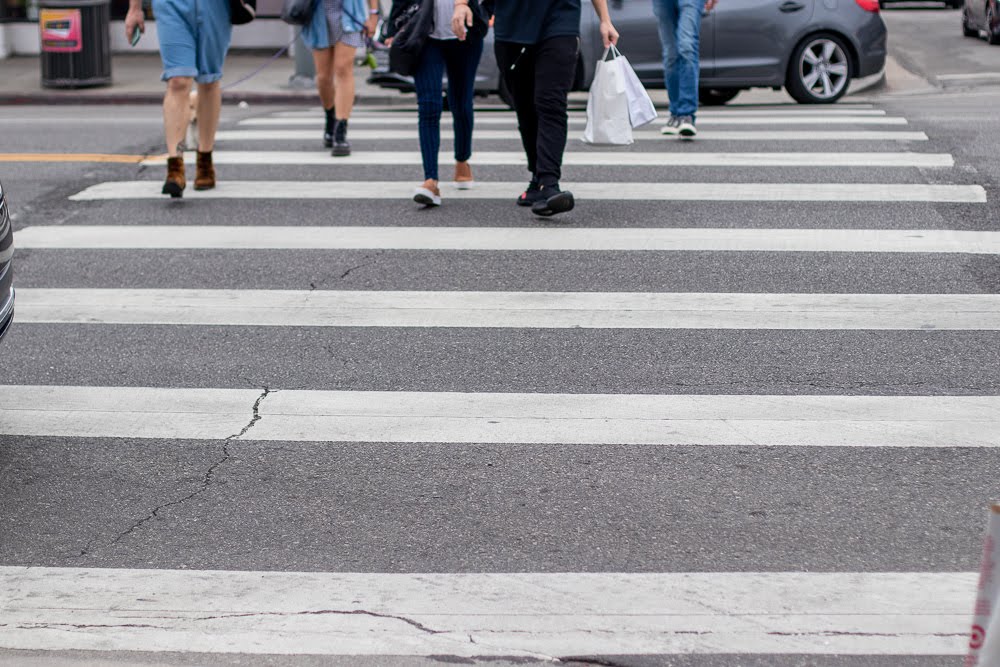
Summer at the shore brings crowds, unfamiliar drivers, and packed boardwalks, and that mix puts people on foot at real risk. A visitor stepping off a curb or crossing a busy beach-town avenue can be seriously hurt in an instant.
The shore's busiest spots are also its most dangerous for pedestrians. Boardwalk trams, jitneys, and rolling chairs share tight space with walkers, while avenues like Atlantic and Pacific carry heavy traffic a block from the beach.
Crosswalks fill with distracted visitors, and drivers unfamiliar with the area often miss people stepping into the street. The seasonal surge in traffic multiplies every one of these risks between late spring and early fall.
Drivers searching for parking, families crossing mid-block toward the sand, and the mix of local and out-of-state cars all add to the danger on a summer weekend.
There is an important point in a struck pedestrian's favor. New Jersey's verbal threshold under N.J.S.A. 39:6A-8 limits when many drivers can sue for pain and suffering, but it generally does not apply to pedestrians, who are not required to carry Personal Injury Protection on a vehicle.
That means an injured pedestrian can usually pursue noneconomic damages without first proving the case fits one of six statutory injury categories. Knowing that pedestrians are usually not bound by the verbal threshold often changes what a shore injury claim is worth.
The same generally holds for cyclists struck by a vehicle, who are also not required to carry that coverage.
Most pedestrian cases turn on a driver’s failure to stop. Under N.J.S.A. 39:4-36, a driver must stop and remain stopped for a pedestrian crossing in a marked crosswalk, and the same duty applies at unmarked crosswalks at intersections. A driver who was speeding, distracted, or ignoring foot traffic can be held responsible for the harm.
Pedestrians have duties too. Under N.J.S.A. 39:4-32 and 39:4-33, they must obey traffic signals and generally use crosswalks, and those rules can affect how fault is divided when someone crosses mid-block or against a signal.
Depending on the facts, a tram or shuttle operator or a property owner may also share fault. If a public entity operated the vehicle or maintained the roadway, the Tort Claims Act applies. It requires written notice of the claim within 90 days of the incident (N.J.S.A. 59:8-8), and a lawsuit against a public entity for pain and suffering requires a permanent injury and medical expenses above a statutory threshold (N.J.S.A. 59:9-2(d)). Identifying every responsible party early keeps available coverage from shrinking.
Being hurt far from home adds stress to a shore crash. Serious injuries in the region are treated at AtlantiCare Regional Medical Center, the area’s state-designated Level II trauma center, which operates campuses in Atlantic City and in Galloway Township.
How medical bills get paid depends on your insurance. If you have your own auto policy that includes New Jersey-style Personal Injury Protection, that coverage generally follows you, not the car, so it can apply even when you were walking.
Many other states do not use a no-fault system, so an out-of-state visitor’s policy may offer only limited medical payments coverage or none. A pedestrian with no PIP of their own may be able to claim benefits through the insurer of the vehicle involved and, if the driver was uninsured, through the state’s uninsured-claims fund.
How your PIP interacts with health insurance, including whether you elected health insurance as primary, also affects how bills are paid. Keep the crash report, medical records, and receipts organized to make coordinating coverage easier. Get the driver’s name and insurer at the scene if you can, since tracking down an out-of-town or seasonal driver later can be difficult.
Shore pedestrian cases often involve visitors who have gone home by the time they realize how serious an injury is, which makes prompt documentation and quick legal help especially valuable.
The Budanitsky firm helps injured pedestrians pin down the driver's fault and line up the coverage that applies, wherever the client lives. Attorney Sander Budanitsky has represented injured New Jersey clients since 1996 and knows how insurers try to shift blame onto people on foot.
Contact The Law Offices of Sander Budanitsky, L.L.C., or call (908) 241-3445 to schedule a free consultation. We can review your situation, explain your options, and help you understand what to do next.
Can I sue for pain and suffering if a car hit me while walking at the shore?
Usually yes. Pedestrians are generally not bound by the verbal threshold because they are not required to carry PIP, so they can pursue pain-and-suffering damages.
I was visiting from out of town when I was hit. Whose insurance pays?
Your own auto PIP coverage generally pays your medical bills first, even though you were on foot. Losses beyond that can be pursued from the at-fault driver.
Reviewed by Sander Budanitsky, Esq., admitted to the New Jersey Bar in 1996.
Last reviewed: November 2026
This article is for general information only and is not legal advice. Reading it does not create an attorney-client relationship. For advice about your specific situation, consult a licensed New Jersey attorney.

If you were hurt on or by an NJ Transit bus or train, you are...

Few experiences are as devastating as losing someone you love because of another person's careless...

A crash involving a large truck is not just a bigger car crash. These cases...

The minutes and days after a Plainfield crash decide more about your claim than most...
The Law Offices of Sander Budanitsky, L.L.C. welcomes calls from potential clients and from attorneys looking to refer or co-counsel a matter. Whether it is an injury claim, a civil dispute, a criminal charge, or an immigration question, the first conversation is free and there is no obligation to hire the firm afterward.
Call the Roselle, New Jersey office at (908) 241-3445 or the Philadelphia, Pennsylvania office at (215) 545-2300. You can also send the details through the contact form and someone from the office will get back to you. Calls are answered 24 hours a day, 7 days a week.
